This week
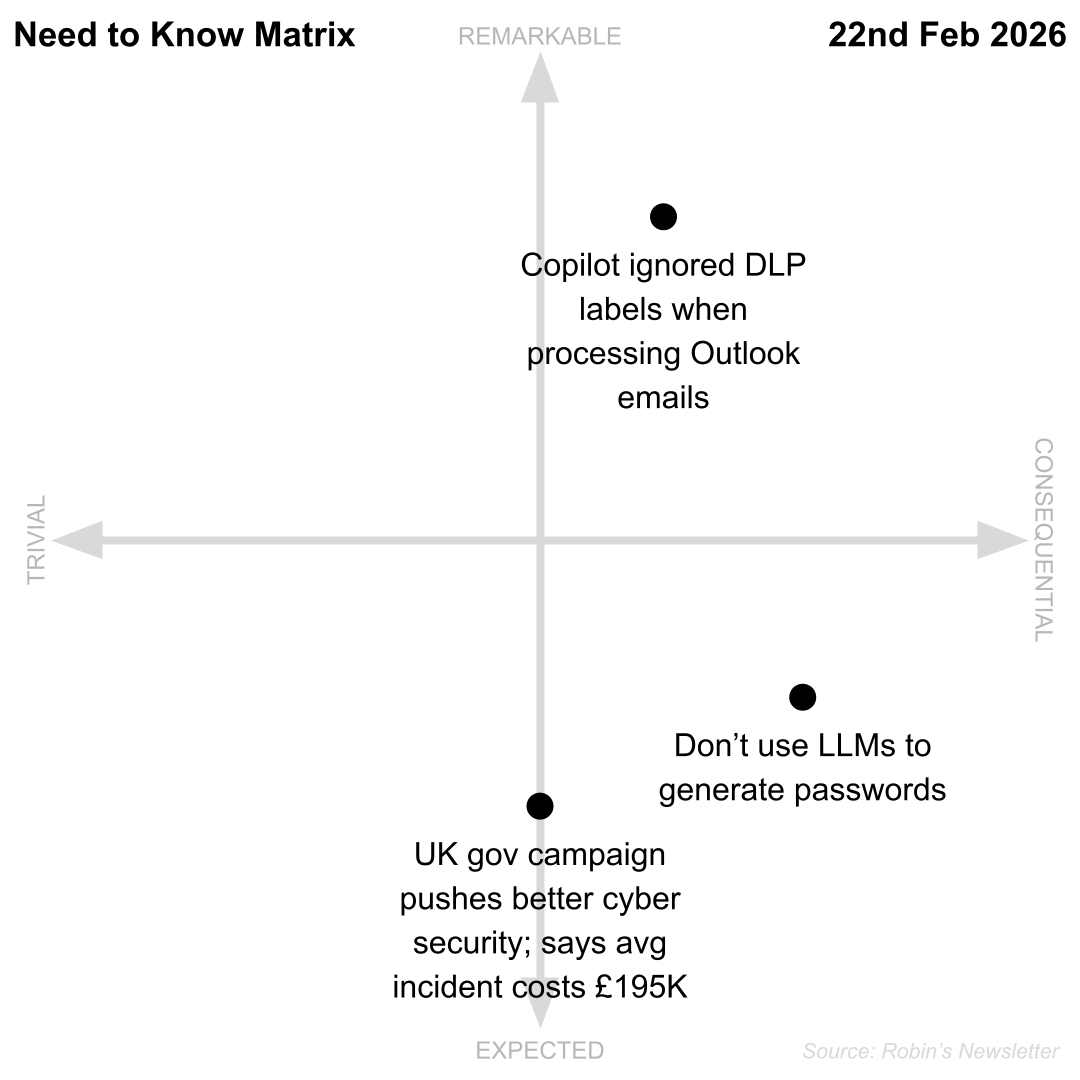
- UK gov campaign pushes better cyber security; says avg incident costs £195K
- Copilot ignored DLP labels when processing Outlook emails
- Don’t use LLMs to generate passwords
Interesting stats
65% of 750 incident response cases worked by Palo Alto’s Unit 42 in the year to September 2025 stemmed from identity, with the primary initial access being obtained via: 33% social engineering, 13% previously compromised /reused credentials, 8% brute force, 8% insider abuse of legitimate creds, and 2% IAM misconfiguration.
Arctic Wolf has also published details of their IR case load between November 2024 and November 2025 (PDF): 44% were ransomware attacks, 26% were business email compromise, 11% related to vulnerability exploitation, and interestingly, in 22% of cases, attackers only threatened to expose information, rather than encrypt it.
1.75 million apps rejected from being published on the Google Play Store in 2025, down from 2.36 million in 2024, last year also saw 80,000 ‘bad’ developer accounts banned.
700 ATM jackpotting incidents were reported to the FBI in 2025, out of 1,900 since 2020 (~1/3).
Five Three things
-
The UK government is encouraging organisations to ‘lock the door’ on cyber criminals. The new campaign follows a longitudinal study that founds 82% of businesses and 77% of charities experienced some form of cyber incident in the past year, costing an estimated £14.7 billion. Significant attacks cost an average of £195,000, and the UK’s Cyber Essentials scheme gets a shout out as 92% fewer insurance claims came from certified organisations. A free online readiness check and 30-minute consultations with NCSC-approved firms are on offer to help companies get started.
-
Microsoft has fixed an issue with Copilot where Copilot Chat for Outlook would summarise emails flagged with “confidential” Data Loss Prevention policies prohibiting their use, if the messages were in the user’s Drafts or Sent folders. While a Microsoft spokesperson told BleepingComputer that “This did not provide anyone access to information they weren’t already authorized to see,” it is a pretty major design flaw. Especially when you consider that, in many cases, copies of emails flagged confidential would end up in the sent items simply by replying to them.
-
It’s hard to be random: Researchers at Irregular have tested different artificial intelligence chatbots and found them terrible at suggesting strong passwords. Claude, ChatGPT, and Gemini all returned what, on the surface, appear to be strong passwords when prompted to generate 16-character passwords that include lowercase and uppercase letters, numbers, and special characters. However, over 50 repeated prompts, Claude returned 20 duplicates, with the same one string being returned 18 times. All three chatbots generated passwords following patterns that reduce randomness in the results, potentially allowing attackers to fine-tune how they might brute-force or guess them. Entropy-wise, the results are estimated to be between 20 bits and 27 bits, where 98 bits is recognised as being the standard for a ‘truly random’ password. Chatbots are just prediction machines — their job is to predict the next most probable character — and so it’s no wonder they return the same or similar results. They are a particularly poor choice for generating passwords. Use a proper password manager.
In brief
-
⚠️ Incidents: Abu Dhabi Finance Week left scans of passports and other identity documents of over 700 attendees accessible in a web-accessible cloud service. The documents included high-profile attendees such as former British Prime Minister Lord David Cameron and former White House Communications Director Anthony Scaramucci, as well as other billionaires, investors, and figures from finance. Sticking with finance… Blockchain firm Figure has confirmed a data breach, at the hands of the ShinyHunters group, and while the company says only “a limited number of files” were stolen, some data puts the number of compromised accounts at over 967,000 accounts. The French government says a “malicious actor” gained access to the country’s National Bank Accounts File. ‘FICOBA’ records all bank accounts in the country, holding data on more than 80 million individuals. A spokesperson said that potentially details of 1.2 million, out of 300 million accounts may have been illegally accessed. A software error in PayPal’s Working Capital loan app exposed the personal information of around 100 users for six months.
-
🏴☠️ Ransomware: The University of Mississippi Medical Center was forced to close clinic locations this week after a ransomware attack prompted a precautionary network shutdown. The patient record system was affected, stoking fears of data extortion. During the disruption, UMMC said, “Patients in our hospital and our emergency department are being cared for. Clinical equipment and operations remain functional.” ShinyHunters claim to have stolen more than 800,000 records, including employee data from casino operator Wynn Resorts, and are demanding $1.5 million. Japanese testing equipment company Advantest has disclosed a ransomware attack on its corporate network.
-
🕵️ Threat Intel: Over 500,000 VKontakte accounts have been compromised via malicious Chrome browser extensions targeting users of the Russian social network. CheckPoint researchers say AI chatbots that can fetch web pages like Grok and Copilot can be used as a proxy for malware command and control: asking the chatbot to communicate with the C2 server, and hoping that the traffic blends in with other legitimate AI requests. ESET says it’s seen new Android malware using AI calls at runtime to lookup accessibility instructions to ‘lock’ or ‘pin’ itself, as these vary from manufacturer to manufacturer.
-
🪲 Vulnerabilities: Mandiant says a maximum severity vulnerability in Dell RecoverPoint has been exploited by a Chinese-linked group since late 2024. The issue (CVE-2026-22769; 10/10; advisory) stems from the use of hard-coded credentials that allow unauthorised access to the underlying operating system. C’mon, Dell! Visual Studio Code (VSCode) extensions downloaded over 128 million times contain data exfiltration and remote code execution vulnerabilities. Ox Security researchers say Live Server can steal local files by getting a victim to visit a malicious webpage (CVE-20205-65717; 9.1/10; advisory), while changes to Code Runner’s configuration file allow remote code execution (CVE-2025-65715; 7.8/10; advisory). Honeywell CCTV products contain a weakness that allows the email address used in the forgot password flow to be changed, essentially allowing an attacker to bypass the authentication of the devices (CVE-2026-1670; 9.8/10; no advisory). Grandstream GXP1600 Series VOIP phones have a vulnerability that allows eavesdropping on calls (CVE-2025-2329; 9.3/10; advisory).
-
🛠️ Security engineering: Researchers from ETH Zurich and Universita della Svizzera Italiana have been busy analysing password managers’ zero-knowledge claims and determined that vaults may be exposed during master password resets, amongst some other scenarios. Amazon’s ‘Kiro’ AI coding tool caused a 13-hour outage after deciding that the best option to fix a problem was to “delete and recreate the environment.” Amazon says AI use was a “coincidence” and the same could have happened with “any developer tool or manual action.” Anthropic is rolling out Claude Code Security, which will scan for and suggest patches to fix vulnerabilities.
-
🏭 Operational technology: In their ninth annual review, Dragos says “adversaries are moving beyond pre-positioning” to understand “how to manipulate physical processes”. Three new threat groups are identified: Azurite, who target engineering workstations; Pyroxene, who use fake LinkedIn profiles in social engineer campaigns and deploy wiper malware against Israel in June 2025; and Sylvanite, who focus on initial access and exploiting edge device vulnerability for Voltize/Volt Typhoon.
-
👮 Law Enforcement: The US state of Texas has filed a lawsuit against TP-Link over alleged “deliberate deception” of the security and privacy of its devices. TP-Link, a Chinese networking company, says the suit is “without merit. Interpol says that African law enforcement have arrested 651 suspects in a cybercrime operation investigating $45 million in financial losses.
-
💰 Investments, mergers and acquisitions: Palo Alto Networks has announced its intention to acquire Koi, to give visibility and policy enforcement into AI, in a deal rumoured to be worth $400 million. VulnCheck has raised a $25 million Series B.
-
🗞️ Industry news: Bug bounty programmes are starting to offer AI-powered pen testing services, and it’s not going down well with their human hacker communities. HackerOne and BugCrowd both say they’re not training their models on user or customer data. Snyk CEO Peter McKay has announced his intention to stand down so the code security outfit can “bring in a leader with deep roots in product innovation and AI.” And big congrats to folks at Crash Override and Geordie for making the RSA Innovation Sandbox 2026 final.
And finally
- Dutch dude detained during data deletion dispute: A ’technical error’ resulted in the 40-year-old man being sent a link that allowed him to download the sensitive law enforcement information, instead of uploading his own images relating to a police investigation. The man said he would only delete the files if he “received something in return”. That confidence in extorting the police appears misplaced, as he was promptly arrested. Golf. Clap.