This week
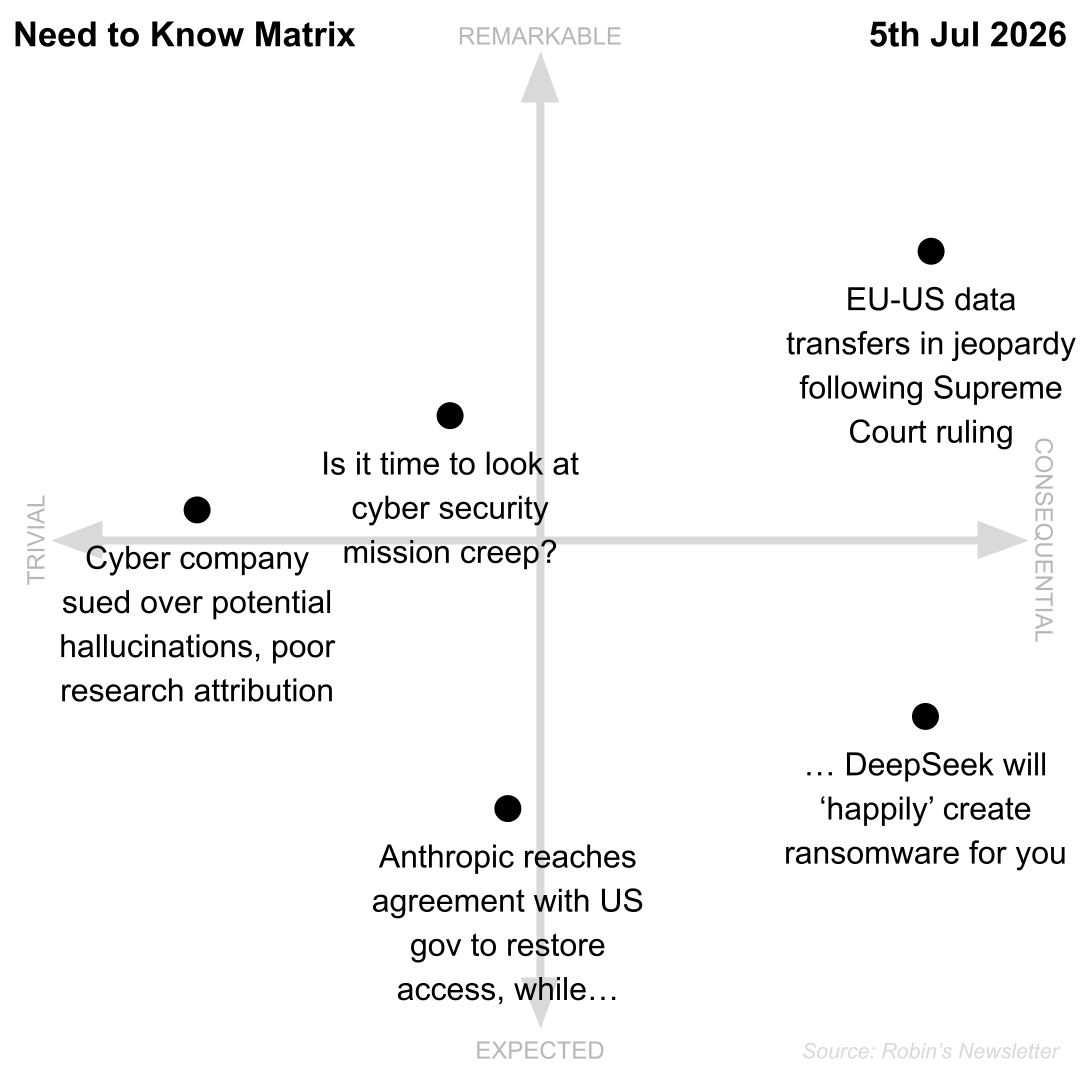
- Anthropic reaches agreement with US gov to restore access
- DeepSeek will ‘happily’ create ransomware for you
- EU-US data transfers in jeopardy following Supreme Court ruling
- Cyber company sued over potential hallucinations, poor research attribution
- Is it time to look at cyber security mission creep?
Interesting stats
9% (a big drop from 2025’s 29%) of organisations are open to a purely automated security scanning approach, in part because 78% of security teams report “critical false negatives” from such tools, according to Cobalt.
37% increase in Google’s electricity use in 2025, mostly down to AI, according to the Mountain View company’s sustainability report.
55% (2025: 58%) of 1,200 IT and security professionals have been asked to keep a breach quiet, according to Bitdefender.
70% of UK consumers say they won’t tolerate more than one day of disruption following a cyber incident, according to TalkTalk Business, which also found that 32% of those surveyed would stop using a service following a breach, with only 4% saying an incident wouldn’t influence their future behaviour.
£488,000 ($653,000) is the average loss from a cyber incident, according to Grant Thornton, who say 79% admit cyber risk ownership remains unclear and only 7% of boards have cyber expertise.
Five things
-
(and 2.) AI Cyber Roundup: The White House has lifted its ban on Anthropic’s latest Mythos and Fable models, after the Claude maker agreed to “proactively detect and address security risks associated with the models”. It comes hot on the heals of Anthropic accusing China’s Alibaba of conducting a distillation attack against its models (and Alibaba banning employees from using Claude). Anthropic has painted itself into somewhat of a corner with its warnings over the capabilities of its newest models, and pushing for them to be regulated. Meanwhile, other models, such as DeepSeek, another Chinese model, lack the same level of safeguards. Researchers from Check Point say they have identified over 1,800 malicious software samples attributed to DeepSeek that have been uploaded to VirusTotal in the past year. One such sample was a browser-based ransomware sample that could be “transformed into a fully functional attack with minimal effort”. Also this week, Sysdig says it believes a large-language model (LLM) conducted a JadePuffer ransomware intrusion, performing reconnaissance on the victim, stealing credentials, moving laterally, establishing persistence, and elevating privilege so it could encrypt data. The direction of travel is clear here: the big, main (Western) models — your ChatGPT, Claude, and Gemini (sorry, CoPilot) — are not likely to be the threat here. Instead, it will be others, and particularly smaller, more specialised, local models that may lead to the sorts of attacks Five Eyes intelligence agencies warned about last week.
-
EU-US Data Transfers: The US Supreme Court granted President Trump powers to remove the heads of ‘independent’ US agencies and regulators this week, potentially undermining the legal framework governing the transfer of personal data from the EU. The European Commission adopted the EU-US Data Privacy Framework in 2023, and it requires an independent US body to provide oversight. If the President can hire/fire the heads of organisations like the Federal Trade Commission (FTC) at will, then the independence of those bodies can be called into question, something activist Max Schrems has vowed to file a legal case arguing. Schrems has form: having won against Meta and invalidated the previous EU-US Privacy Shield framework.
-
Attribution: MeetingTV is suing Koi Security, recently acquired by Palo Alto Networks, over (now deleted) claims that its Zoomcorder meeting recording service was a “public-facing front” for a Chinese espionage operation. According to MeetingTV, Koi’s security researchers did not approach the company for comment before publishing their research and have refused to supply information about the “Twitter X Video Downloader” browser extension, which Koi says links Zoomcoreder to the Zoom Stealer campaign. It’ll be interesting to see how the case plays out. The lawsuit claims the threat intel report was generated by AI and may have hallucinated the link. The damages sustained because security controls now block the company’s services are pretty tangible and should give TI firms something to think about in edge cases.
-
Mission Creep: This paper, due to be published in the University of Illinois Law Review, is an interesting read. It argues that “Cybersecurity is experiencing mission creep” with many public policy issues being reframed as ‘cyber’ issues. Think misinformation, child social media safety, and so on. I’m quite sympathetic to the position: a lot of ‘cybercrime’ is confidence scams that are happy to be carried out in cyberspace rather than in person. The Internet and technology have made it much easier for criminals to reach a global audience, while de-risking their capture by perpetrating these crimes across borders from locations lacking extradition treaties. Is the cyber label an aberration, caused by tech outpacing lawmakers’ understanding? Would we benefit from a more conscious effort to move issues away from technology and back into the domain of their consequences?
In brief
-
⚠️ Incidents: An EY employee in Australia has appeared in court on charges of unauthorised access or modification of restricted data: Prime Minister Anthony Albanese’s banking details, while on a project for the Commonwealth Bank of Australia. Colour me surprised: spyware was found on Stelios Kouloglou’s phone, a former European Parliamentarian on the committee investigating spyware abuses. AdaptHealth says that attackers sweet-talked their way into systems via a third-party contractor in a breach that, “due to the nature and potential volume of the data that is at risk,” it considers material and requires disclosure to the SEC. Agricultural and industrial equipment manufacturer Kubota says threat actors were in its networks for over a month earlier this year, leading to the compromise of US employee details, including names, Social Security numbers and other taxpayer and government ID information, bank details, and benefits information, including details of dependents.
-
🏴☠️ Ransomware: The Japanese subsidiary of US insurance company Aflac has disclosed a breach affecting 4.38 million customers personal and bank account information.
-
🕵️ Threat Intel: The threat actors behind FortiBleed are using or passing off the credentials to deploy ransomware, and new research appears to link both the INC and Lynx ransomware gangs via an opsec fail. Researchers at Jamf say new Pamstealer macOS malware, spoofing a popular legitimate clipboard manager, combines a disk image and AppleScript in a novel way to avoid detection.
-
🪲 Vulnerabilities: Citrix has fixed six vulnerabilities in its NetScaler ADC and Gateway products, including one in the same family at 2023’s CitrixBleed (CVE-2026-8451; 8.8; advisory). Adobe has patched six ‘perfect 10’ critical ColdFusion vulnerabilities that can be exploit to gain remote code execution (CVE-2026-48276, -48277, -48182, -48316, and -48282; all 10/10; advisory). Oracle sysadmins should update to avoid a collection of low-complexity critical vulnerabilities (CVE-2026-46817; 9.8/10; advisory).
-
🛠️ Security engineering: Telegram bot developers should check if they’ve used any of a bunch of Python packages that have been compromised with a backdoor.
-
🧿 Privacy: The US Supreme Court has ruled that law enforcement must obtain a search warrant when requesting geofence location data from technology companies as “an individual has a reasonable expectation of privacy in his cell-phone location information” under the Fourth Amendment. Papa Johns teamed up with Instacart and NBC Universal to stream targeted ads to customers when they predicted that they would be low on groceries.
-
📜 Policy & Regulation: The US Department of Homeland Security is to resurrect a CNI intelligence-sharing organisation. ANCHOR-CI (Alliance of National Councils for Homeland Operational Resilience – Critical Infrastructure) will replace the Critical Infrastructure Partnership Advisory Council, which the administration abolished a year ago, but will now be exempt from transparency laws. The UK’s National Cyber Action Plan has been delayed due to the leading Labour Party’s leadership election.
-
👮 Law Enforcement: The US is offering up to $10 million for information leading to the identification of two Russian-linked adversaries — UNC5792 and UNC4221 — that have been targeting US officials’ Signal and WhatsApp accounts.
-
💰 Investments, mergers and acquisitions: Congrats to the team at Osney Capital on closing their oversubscribed debut cyber fund at its £60 million hard cap.
-
🗞️ Industry news: Visa has launched a threat intelligence platform combining cyber and payments intelligence to help banks detect fraud faster. Presumably this is at least partially a response to MasterCard’s acquisition of Recorded Future. Israeli auto-cyber startup PlaxidityX (née Argus) is shutting down operations and laying off its remaining 80 employees. Argus was acquired in a 2017 deal estimated at $450 million.
And finally
- A good read, from Bruce Schneier, who makes the historic comparison to L0pht group’s congressional testimony against the AI threat that Five Eyes intelligence agencies warned about last week, as AI reduces the skill needed to conduct cyber-attacks.