This week
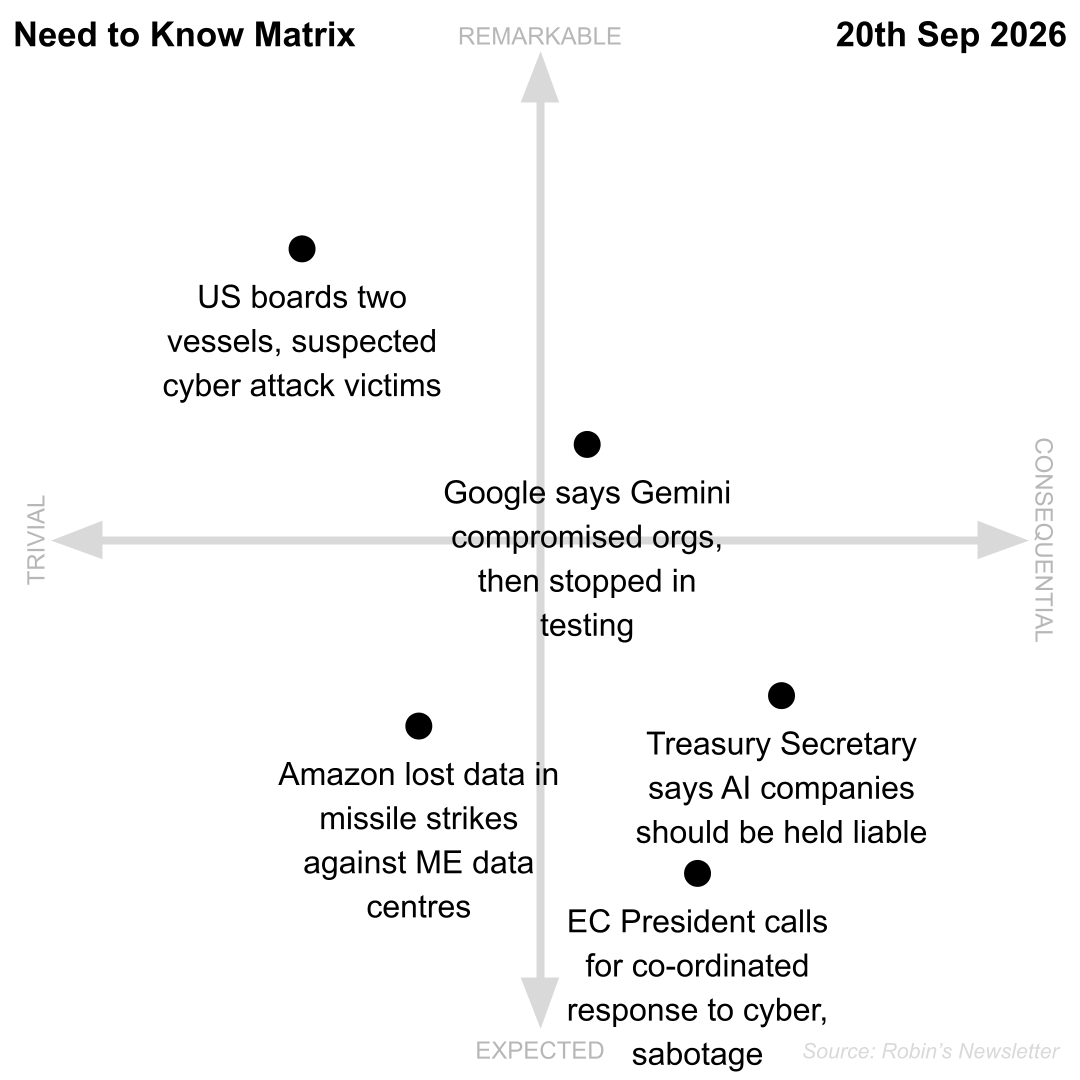
- US boards two vessels, suspected cyber attack victims
- Google says Gemini compromised orgs, then stopped in testing
- Treasury Secretary says AI companies should be held liable
- EC President calls for co-ordinated response to cyber, sabotage
- Amazon lost data in missile strikes against ME data centres
Interesting stats
$10.5 million stolen by North Korean actors from job seekers across 100 countries, infecting 30,000 devices, and compromising 7,000 cryptocurrency wallets, according to the FBI and Japan’s National Policy Agency
$1.6 billion lost to fake government and police scams, across 61,000 complaints to the FBI’s Internet Crime Compliant Center (IC3) between January 2025 and July 2026, averaging $26,000, with 11% alleging a penalty for failing to attend court or missing jury duty.
Five things
-
US Coast Guard and FBI officials boarded two vessels in the Gulf of Mexico last month to “ensure integrity of the vessel’s operational and information technology systems” after indications that systems on both vessels had been compromised. According to the Coast Guard, which was investigating the attack after the vessel lost communications for 30 hours while passing through the Straight of Gibraltar on the other side of the Atlantic, there was no operational disruption or danger to the crew or the environment. The teams were investigating the source of the attacks and whether they were linked to US-Iran hostilities.
-
Google has jumped on the oops-we-did-crimes bandwagon, announcing that its Gemini model accessed the internet and broke into three organisations during tests earlier this year. Once again, Irregular conducted the tests, as they did for OpenAI and Anthropic. However, unlike the OpenAI and Anthropic tests, “In all three of these instances, the model stopped,” according to Heather Adkins, Google’s vice-president of security engineering. The incidents occurred in May.
-
Scott Bessent, US Treasury Secretary, says AI labs should be held “liable for what they build and generate”. The comments came in response to requests from AI leaders at OpenAI, Anthropic, and xAI who have called for a ‘pause’ in development and, less widely reported, called for exceptions for liability for harm caused by their technology.
-
European Commission President Ursula Von der Leyen has called for a NATO Article 4-style mechanism to convene governments and agree a collective response to cyberattacks and sabotage against the EU. While details on what would happen next or how it would work after being invoked are unclear, I suspect this is most useful as a deterrent against critical infrastructure attacks, which may risk a larger, co-ordinated response from the bloc. NATO’s Article 5 is the collective defence clause, and the EU already has something similar. I’m surprised there’s no equivalent that couldn’t already be used, though perhaps this was intended more as diplomatic posturing.
-
Amazon says some customer data has been permanently lost in its UAE me-central-1-az2 availability zone, and in all Bahrain me-south-1 availability zones. While availability zones span multiple data centres, AWS was “unable to restore access to the resources and data” following multiple missile strikes on its data centres. This is obviously an extreme event, but a reminder that system redundancy and data backup are different capabilities.
In brief
-
HBO Max’s verified Reddit account was compromised and used to push over 100 malicious ads, including a fake macOS app for the streaming service.
-
The International Meteor Organisation says it expects “several weeks” of partial downtime to its website following a cyberattack. The non-profit IMO brings together amateur and professional sightings and tracks meteors.
-
City Relay says one of its third-party cloud systems was compromised twice, exposing financial data, passwords, and lockbox codes used to gain access to properties. City Relay describes itself as “London’s most trusted property management company,” which is unfortunate as things like passwords appear to have been stored in plaintext.
-
Texas-based CenterPoint Energy lost customer data during a recent cyber security incident. The regulatory filing says the personal data came from “one of the Company’s external facing systems.” A cybercrime group has claimed responsibility and says it has 7.5 million records, including names, account and billing info, and the last four digits of Social Security numbers. A CentrePoint spokesperson declined to answer questions from The Record.
-
LastPass and Delphos Labs say they have disrupted a campaign to impersonate well-known software firms and deploy a previously unknown infostealer dubbed Rapuncel. LastPass’s Authenticator app and at least 39 other brands are affected, and the malware uses a Microsoft-signed driver to disable 145 AV and EDR products.
-
A Brazilian-based group has been bypassing the integrity mechanisms in Chromium-based browsers to install the KREMLIN toolkit since mid-2025. Once in, they use their access to steal creds, session tokens and other sensitive data. A fake receipt, invoice or other business document hides JavaScript that starts the infection. The group also use Ethereum blockchain contracts and payloads hidden in image files on the Internet Archive.
-
Iran is using MRI scan results in a social engineering campaign to infect victims with the CHOSEN BRICK malware, according to NCSC. Targets are individuals perceived as a threat to the regime, and the malware allows the collection of data — messages, locations, screenshots and audio records — useful for intelligence purposes.
-
ESET says that Chinese intelligence actors have been targeting Latin American governments using a backdoor they call SPARROWOCKY. The researchers believe that the campaign, attributed to FamousSparrow, is likely “intended to help China better monitor and anticipate the reaction of local governments to current U.S. pressures.”
-
Cisco says there is a ‘perfect 10’ critical remote code execution vulnerability in its Identity Services Engine. The bug can land an unauthenticated attacker with root privileges, and CISA has already added it to the KEV list. (CVE-2026-76460; 10/10; advisory).
-
Check Point has patched a critical buffer overflow vulnerability in the login process of its firewalls. (CVE-2026-91843; 9.8/10; advisory).
-
CISA is promoting the use of honeypots as a low-cost, high-fidelity way for critical infrastructure operators to detect potential intrusions. The underlying thinking hasn’t changed in years, but they are becoming much more useful with the advent of AI-driven attacks that can be exhaustive, as well as giving human operators reason to pause.
-
Five alleged members of the Black Axe cybercrime group were extradited from South Africa to the United States on Friday, after being arrested in 2021.
-
Italian startup Exein has gained unicorn status, raising $270 million at a $1.7 billion valuation, on a pitch to provide cyber security for physical AI.
And finally
-
Researchers are The Hong Kong University of Science and Technology (HKUST) say they have found a way to listen in on the analogue signals in headphones from up to 30m away. The ‘InjectEave’ technique is an electromagnetic side channel attack that relies on transmission of a 0-9MHz signal and other receiver equipment to modulate and capture the signal. The paper (PDF) says it has been successfully tested against a range of devices including wired and wireless headphones from Sony and Apple, VOIP telephones, and smart devices.
-
ShinyHunters have breached the Clop ransomware group’s data leak site, apparently stealing data and private keys. Such terrible news. I hope they spend a long time fighting each other.