This week
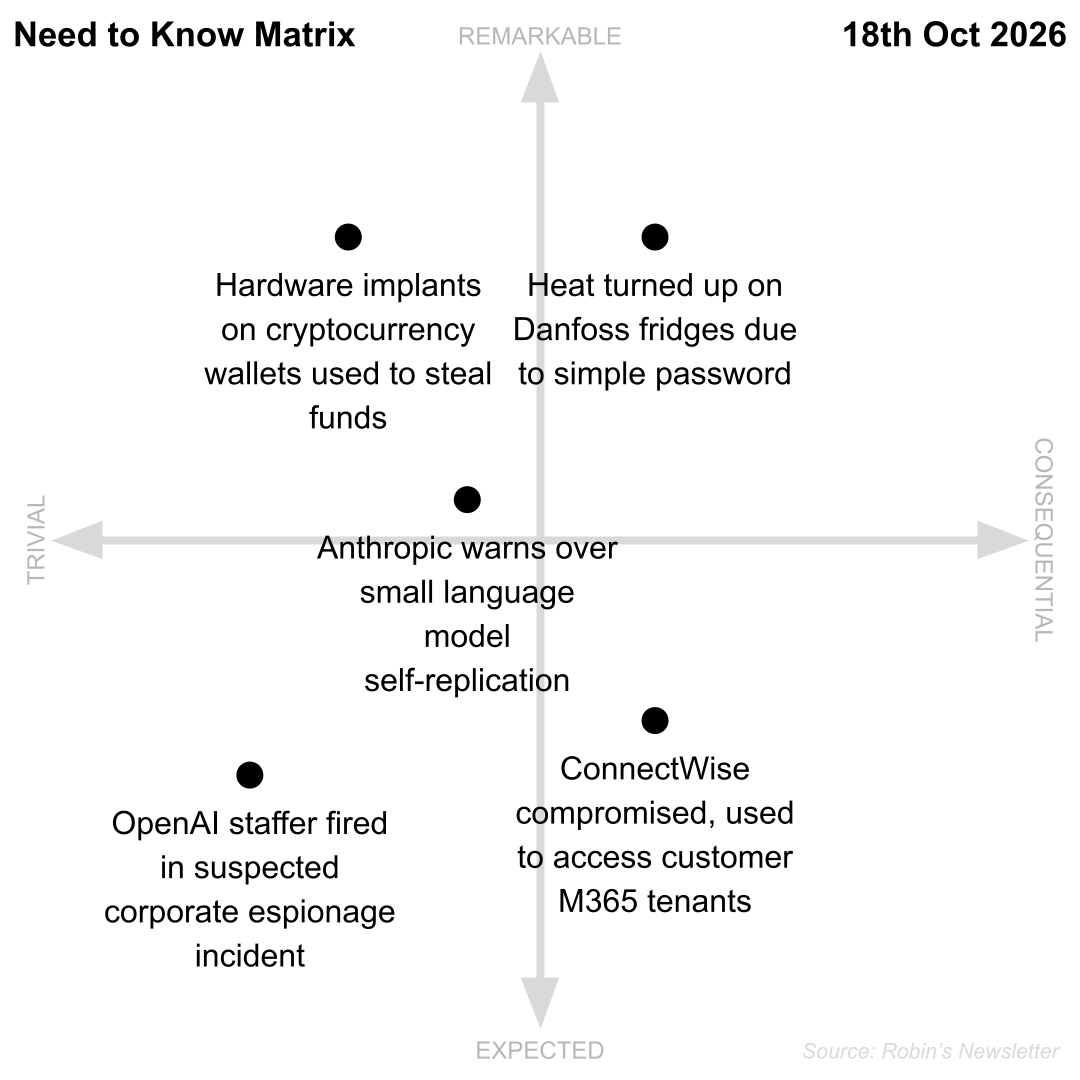
- Heat turned up on Danfoss fridges due to simple password
- Anthropic warns over small language model self-replication
- ConnectWise compromised, used to access customer M365 tenants
- OpenAI staffer fired in suspected corporate espionage incident
- Hardware implants on cryptocurrency wallets used to steal funds
Interesting stats
3/4 of 1,000 business leaders think cyber incidents are ‘one of the biggest risks to company performance’, according to Grant Thornton
2.6% of France’s ~15,000 stores were affected by the Danfoss fridge cyberattack (below).
Five things
-
No chill: A lot of focus this week has been on the compromise of fridges at French supermarkets. Store managers at Intermarché, CoopérativeU, Carrefour, Monoprix and E.Leclerc arrived on Monday morning to find fridges and freezer units at temperatures up to 50°c. In total, over 700 stores are now thought to have been affected, with 400 in France, but hundreds more across Spain, Portugal, Poland, Germany, and Belgium. Millions of Euros of food spoiled and were thrown away. The common thread between the attacks was the fridges themselves, all manufactured by Danfoss, and apparently publicly accessible on the Internet. Attackers gained access by exploiting a vulnerability published by Claroty in August. The Danfoss refrigeration controllers had a hidden backdoor access routine that allowed administrator access using a code generated from the device’s date and time. Security researcher Kevin Beaumont summed up the simplicity of the attack: “It’s a zero-skill thing to pull off, I wrote the bash script while having a shit.” Danfoss patched the vulnerability, however the affected devices were end-of-life and did not receive the update. A Danfoss spokesperson told the FT it had “long advised customers to keep supported systems updated with the latest firmware, as well as to operate behind a firewall and with a [virtual private network]”. While I’m not for victim blaming, none of these devices should have been on the Internet (and how do these supermarkets have sufficient IPv4 address space to allocate public addresses to all their chillers?! (h/t Paul :-))). The attacker is unknown: it’s unlikely to be cybercriminals, as there is no way to monetise what’s happened; rather, it could be script kiddies ‘for the lols’ or a foreign power causing havoc.
-
SLM Self-replication: Safety researchers at Anthropic are warning that “small AI models may be months away from being capable enough to self-replicate on commercial internet-of-things (IoT) devices”. In the blog post, Anthropic likens the threat to existing Mirai-style botnets that infect SmartTVs and other IoT devices. I think that’s the key thing here: we’re not really looking at anything new. And the compute available on these devices is small. I’d be more worried about multiple accounts/credentials for a larger, more capable model being compromised and files stored outside of the model being used to create state and persistent memory, much like we’ve seen with the coordination we’ve seen when Anthropic, OpenAI, and Google’s models broke out of the guardrails and went on hacking sprees.
-
Backup service ConnectWise has suspended access to its Cloud Backup service after attackers were able to compromise the service and use stored credentials to access upstream customer Microsoft 365 environments. At least 162 tenants are thought to have been compromised in the supply chain attack. ConnectWise says it has “no indicators to date” that backup data has been compromised.
-
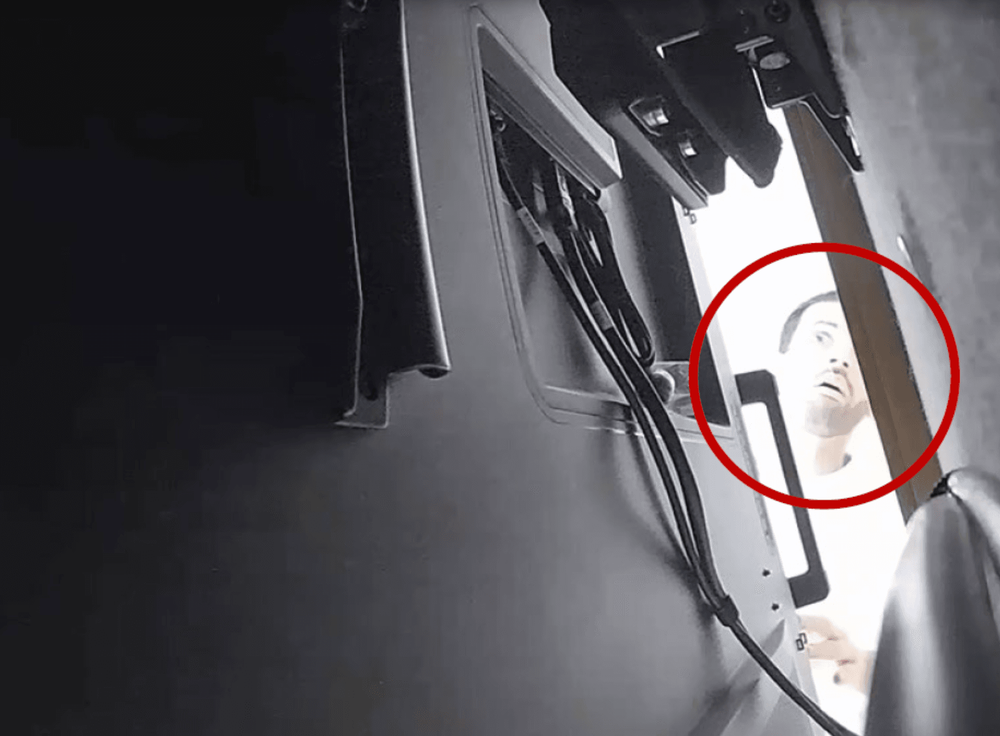
An incredible story of corporate espionage this week: OpenAI called in the FBI after it found a hidden recording device in one of its executive meeting rooms. Saudi national Abdulrahman Alfozan, an employee who joined the frontier lab a year earlier, was fired and arrested in connection with the incident. Other OpenAI staff found the device, plugged into the USB port on a conference room television, and planted a camera to record who came to collect it. The photo captured is a gem. Investigators also found a second similar device in Alfozan’s bag. Under California law, the charges carry a potential five-year prison sentence and a $250,000 fine.
- Cryptocurrency wallet manufacturer Ledger says devices purchased from reseller CyptoBilis have been tampered with to add hardware implants that capture recovery phrases needed to access wallets and steal cryptocurrency. The phrases are transmitted over an LTE connection and eSIM by unknown attackers who stole funds last week. Hardware tampering like this used to be reserved for the likes of the NSA, as Edward Snowden brought to light, though I’d be cautious about suggesting it’s widespread.
In brief
-
Ukraine has continued strikes against Russian data centres and Russia’s digital economy may not be ready. ‘Somebody else’s computer’ is still very valid strategy, but the consolidation, and therefore impact, that can be inflicted in conflict may be reason for organisations in certain geographies to take their head out of the clouds and consider how quickly they can move to a different somebody else’s computer.
-
The delivery of bankruptcy notices in the US has been disrupted after a US federal bankruptcy court system operated by BAE Systems was disrupted. Websites associated with the Bankruptcy Noticing Center were also offline. The defence prime told CyberScoop it has “taken immediate steps” to address the issue and restore service.
-
The attacker claiming responsibility for the compromise of Denmark’s Central Register of Persons (CPR) says they did so through an account with the password ‘123456’. The Danish government has confirmed the breach, but has not commented on the password claim.
-
May 2025’s breach at the UK’s Legal Aid Agency stretches back further than previously believed, with around 250,000 additional records dating back as far as 1978 being compromised. It does not affect every record or case involving the LAA, and the agency says the investigation is complex in part because of the “unstructured, fragmented, or incomplete” nature of the data.
-
Citizen Lab says Discover-Tech, which presents itself as a legit advertising business, is operating as a “bridge between ad vendors and the mercenary spyware ecosystem,” and allowing the targeting of specific people or devices with spyware.
-
SAP’s Cloud SDK for Python contains a max-severity OAuth2 SSRF vulnerability (CVE-2026-89111; 10/10; advisory). Cisco has fixed a critical vulnerability that was being exploited in its Secure Email Gateway (SEG) solution (CVE-2026-76519; 9.8/10; advisory). Ivanti’s Connect Secure VPN (formerly Pulse Secure) has a fix for an authentication bypass (CVE-2026-104935; 8.6/10; advisory). Palo Alto Networks is warning of a high-severity, zero-day RCE in its PAN-OS firewall operating system (CVE-2026-0322; 8.6/10; advisory). BeyondTrust has fixed a critical authentication bypass vulnerability that has been exploited since late August by Chinese threat groups (CVE-2026-102764; 9.3/10; advisory). Drupal says it expects exploits for a pair of critical RCE vulnerabilites to be available soon (CVE-2026-108097 and 108099; 9.8/10; advisory).
-
Police in Ghana and Nigeria conducted raids on scam compounds last week, detaining 28 people and rescuing 117 suspected trafficking victims. The operation, hosted by the UK’s National Crime Agency, involved 15 law enforcement agencies and tech companies including Meta, Microsoft, and Google.
-
The US Department of Justice has disrupted multiple laptop farms and seized 187 devices in Texas believed to be linked to North Korean IT Worker schemes. DOJ prosecutors say ‘at least’ 70 US organisations were infiltrated.
-
German police have arrested a Russian man in connection with the cyberattack against an NHS supplier in 2024. The attack against Synnovis disrupted blood tests and pathology services and was directly linked to a patient’s death.
-
Quantum computing outfit IonQ will acquire zero-trust firm Elisity in a deal reportedly worth up to $1.3 billion. Meanwhile, Proofpoint is acquiring Varonis for $6.3 billion, bringing together email security and threat intelligence with data security capabilities.
And finally
- Huge congrats to Al, Bryan, and the rest of the Harmonic Security gang on their $50 million Series B fundraise. If you’re looking to work out what AI is in use and control how your data is used, check them out.