This week
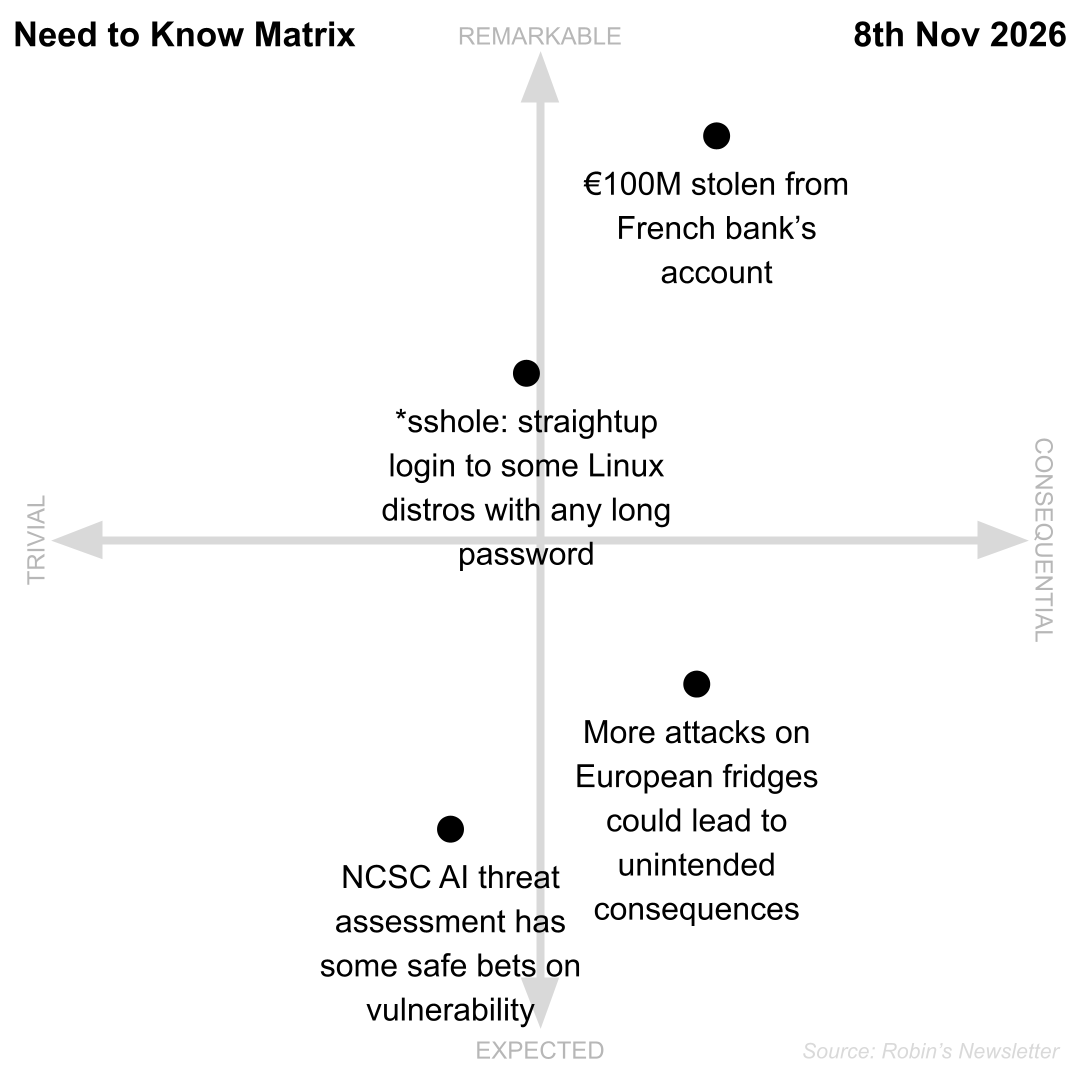
- More attacks on European fridges could lead to potential unintended consequences
- €100M stolen from French bank’s account
- NCSC AI threat assessment has some safe bets on vulnerability
- *sshole: straight-up login to some Linux distros with any long password
Interesting stats
200 organisations targeted in attacks by Chinese actors using the ARTEX, an open-source AI pen testing framework since 17th October: ARTEX is looking like it could replace CobaltStrike as the tool of choice for threat actors of all walks.
~Five~ Four things
-
A second attack against European supermarket freezers in as many months has resulted in food being spoiled and thrown away at shops in Belgium, Luxembourg, Sweden, Ireland, the Netherlands, Estonia, and Finland. One affected Belhaize branch just outside the Belgian capital, Brussels, estimated stock valued at over €100,000 (£84K) had to be disposed of. While attribution is lacking, Noname057(16) and Z-Pentest Alliance claimed responsibility for the previous Danfoss. It doesn’t appear to be financially motivated, and hacktivists typically want to make more of a splash, so this may be a hybrid attack. But as a reminder of unintended consequences, the French blood service, EFS, also said the temperature and defrosting thresholds in its fridges were raised to “very high levels”, but that it had caught the issue and intervened before any products were compromised. In all of these cases, the remote control systems for these fridges and freezers should be accessible only from a secure remote-access network. If you’re a supermarket (or blood service) exposing these devices on the internet and relying on patching in time, this will become a recurring theme.
-
Unknown threat actors stole €100 million (£84M; $111M) from French bank Crédit Mutuel Arkéa this week. The attackers broke into the bank’s account via a service provider’s platform and quickly converted the stolen funds to cryptocurrency and moved them to providers that cannot freeze accounts. No customer accounts themselves were compromised, and the bank does not believe human error is to blame. This is really unusual for a European bank, which are subject to pretty strict regulation. The actors are unknown, but it has hallmarks of North Korea: stealing €100M gets a lot of heat, so you’re either in a Steve Soderbergh movie, or you don’t care because you’re not going to get caught.
-
NCSC has assessed the AI cyber intrusion threat to UK interests through 2028. Their conclusion: it’s 80%-90% likely that Russia, China, and other nation-states will routinely use AI to pursue geopolitical goals; for critical national infrastructure, there’s a 55%-75% chance that attackers will apply AI against known vulnerabilities in legacy technology, and an 80%-90% chance of an AI-powered ransomware attack on UK CNI. Finally, it’s ‘almost certain’ (90%+) that “many systems will remain vulnerable”. All of these seem like safe bets — hello death and taxes — but it’s useful for CNI cyber teams to have an authoritative statement like this to add weight to their briefings.
-
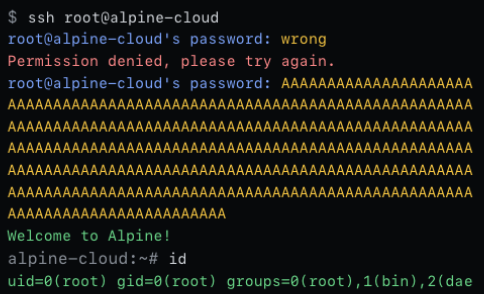
Anyone running OpenSSH on Linux distros using the musl C library, such as Gentoo, OpenWRT, and Alpine, may be vulnerable to ‘*sshole’. Anyone who can reach the SSH server can log in as root by sending any long password. The system needs at least one account whose password field is configured as
*(common for certificate-based auth). The issue has been present since 2016. More. (H/t Dave).
In brief
-
Russia’s second-largest domain registrar, Beget, says “restoring all services” from a cyberattack that wiped data across its infrastructure and disrupted ‘hundreds’ of websites will “take a considerable amount of time”. Russia has spent the last decade consolidating digital services under domestic control, even testing disconnections from the wider internet, but Ukraine has recently realised this presents a weakness and begun striking at technology targets. Also this week, a suspected Russian cyberattack against Ukraine news website The Kyiv Independent saw fake news stories and newsletters being sent to readers, including a rather preposterous claim that Ukrainian President Volodymyr Zelensky had launched a nuclear warhead at Kyiv.
-
Password manager mSecure has warned customers to change passwords, reset multi-factor authentication, and remove passkeys following an intrusion during which an unauthorised attacker made off with an encrypted customer database.
-
Bad news if you’re a DreamHost customer: the firm says that customer files and whole inboxes were stolen during a months-long breach of its systems. The web hosting company has been tight-lipped about the incident, drawing criticism from customers, beyond regulatory filings and comment that “well under 10%” of its 400,000 customer base are affected. Your inbox is a gold mine of information about you, your purchases, accounts, and so on, especially if they had persistent access and were able to affect password resets on accounts.
-
Certificate authority DigiCert says it has suffered a data breach during a server migration that exposed an internal system to the internet. The breach affects a ‘small portion’ of archived customer data, but may include names, email addresses, phone numbers, and postal addresses of business customers, and personal information on documents like driver’s licenses, passports and utility bills provided by individuals to verify their identities.
-
Other breaches: Blockchain intelligence company Chainalysis says it suffered a breach exposing credentials and tokens of all of its users and Who Gives a Crap customers in Australia, UK, and US may have had their data exposed after a marketing software provider was caught with its trousers down.
-
Google Threat Intelligence Group report on so-called LLMJacking. TL;DR: bad guys will target things of value and you should monitor spend so you can catch it quickly. I don’t love coming up with a new term for it. Stealing resources is nothing particularly new: bandwidth to execute DDoS attacks, compute to mine cryptocurrency, and so on.
-
A British Army soldier has been court-martialed for ignoring warnings to remove the SIM card from his mobile phone while on deployment in Estonia, close to the Russian border. His phone was compromised, nude pictures stolen, and blackmailed before reporting the incident to his superiors.
-
Perimeter patching: Ivanti fixed two more 0-days in its Connect Secure remote access gateway, a local priv-esc and predictable filename vulnerabilities respectively (CVE-2026-111357, -118527; 8.8, 4.3/10; advisory). SonicWall firewalls have a fix for a SSL-VPN MFA bypass that’ being exploited in attacks (CVE-2026-19868; 8.8/10; advisory).
-
Market moves: CrowdStrike is acquiring Fiddler AI and Dreadnode for a rumoured $400 million and $95 million respectively, to boost AI observability and testing capabilities to its toolbox. Not to be left out, Palo Alto Networks is reported to be in talks to acquire Clutch Security for $500 million (a 50x ARR valuation) to bolster its own AI agent security capabilities.
And finally
- Videostrong, a Google OEM partner manufacturer compromised Android TV boxes. The ‘MECOOL’ branded smart TV devices phoned home after setup to install a backdoor. Over 1.3 million devices were infected before Google took action to neutralise the botnet and terminate Videostrong’s partner status. Apparently, installing the malware automatically after setup was enough to circumvent Google’s certification processes, raising questions about their thoroughness. If you’ve got a MECOOl, or other cheap, white-labelled Android TV box, it’s worth checking this list of 182 affected device types.